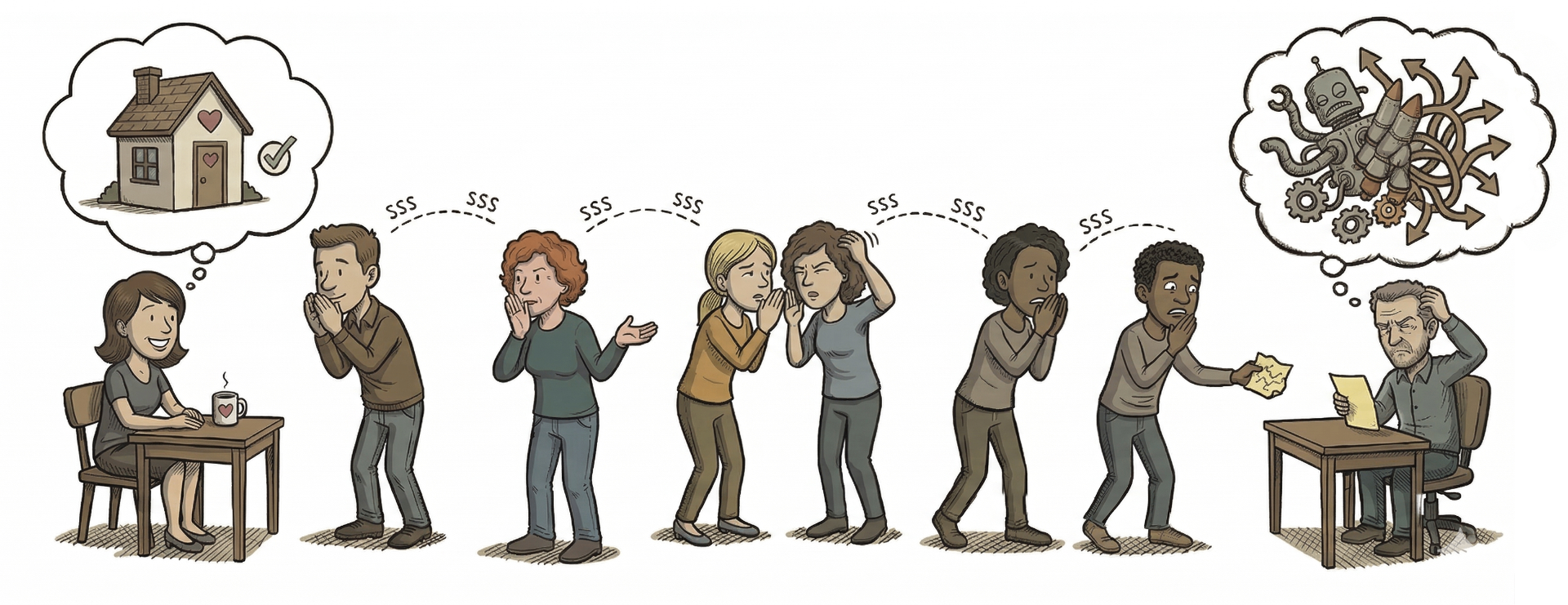
You can't build great products with secondhand insight
Your team isn’t connecting with customers.
Not really.
You’re getting summaries. Bullet points from Sales. Ticket data from Support. Feedback filtered through three layers of “stakeholders.” By the time you hear it, the customer’s actual words are gone. You’re building on assumptions about assumptions.
The Customer Conversation Compass is how you fix that.
CONVERSATION COMPASS FIVE PILLARS
1
Conversation Debt
Every day you don’t talk to customers directly, the gap grows. What you think they need drifts further from what they actually need. That’s debt. It compounds.
How I help: I run workshops that surface where your assumptions are hardest and help you identify which customer conversations you’re avoiding. Then we prioritize which debt to pay down first.
2
Conversation Refactoring
Sometimes you’re asking the wrong questions. Leading them. Rushing them. Getting answers that sound good but mean nothing.
How I help: I catch the moments where you’re accidentally steering the conversation and teach you how to ask questions that get real answers instead of polite ones.
3
Conversation Architecture
Good conversations don’t just happen. Who talks? When? How do you capture it without killing it?
How I help: I build a system that makes customer conversations part of how your team works—not an extra thing someone has to remember to do.
4
Conversation Amplification
One person hearing the customer isn’t enough. The insight needs to reach everyone building the product, not watered down, not summarized to death.
How I help: I create ways for customer voice to reach your whole team directly so the people making decisions hear what customers actually said, not what someone thinks they meant.
5
Conversation Traction
Conversations without action are just theater. The insights have to turn into something real.
How I help: We turn what you’re hearing into decisions and movement so customer conversations actually change what you build, not just what you say in meetings.
Conversation Lab is a comfortable, casual virtual gathering I host once a month at no charge for senior-level community professionals across the country. I designed it as a free, small group, no-sales event where people can relax, relate and get real about the challenges and rewards of customer conversations.
“Conversation Lab was the first time in a long while I didn’t feel like I had to perform or defend my thinking. It was just five smart people talking honestly about how customers show up in real work. I left with clearer ideas, a few uncomfortable realizations, and notes I actually used the next week. That almost never happens.”
– Chief Product Officer, Mid-size tech firm
What is the Customer Conversation Compass?
The Customer Conversation Compass is a practical framework for helping product teams regain control of their customer relationships. It focuses on designing how conversations happen, not just collecting more feedback. The goal is clearer insight, stronger judgment, and better product decisions.=
What problem does this actually solve?
Most product teams run on secondhand insight. Feedback gets filtered through tools, teams, dashboards, and summaries until it barely resembles what customers actually said. The Compass helps teams replace reactive, fragmented input with intentional, high-quality conversations that compound over time.
Is this a research framework?
No. This is not a research method, a survey system, or a replacement for discovery practices. It is a conversation design framework. It helps teams decide when to talk to customers, why they are talking, who should be involved, and how insights get translated into real product decisions.
Who is this for?
Product leaders and teams who:
Feel disconnected from real customer reality
Rely heavily on dashboards, tickets, or proxies
Want better judgment, not just more data
Know conversations matter but haven’t operationalized them
If your team says “we should talk to customers more” but never quite does, this was built for you.
How is this different from “talk to customers more”?
The Compass is about better conversations, not more conversations. Random interviews and reactive calls often create noise, not clarity. The Compass gives structure to conversations so they produce learning, alignment, and confidence instead of opinions and anecdotes.
What does the Compass work actually include?
The Compass typically covers:
How customer conversations fit into everyday product work
How teams listen without bias or agenda
How insights get translated into priorities and tradeoffs
How the conversational soft skill becomes a repeatable capability
It is designed to be learned, practiced, and applied, not documented and forgotten.
In practice, Compass work usually covers:
Designing how conversations fit into everyday product work
Building shared listening skills across the team
Translating what customers say into clear decisions
Reducing conversation debt and fragmented insight
Turning conversation into well-practiced soft skill
Is this training, consulting, or a framework?
Yes.
In practice, it shows up as hands-on workshops, coaching, and applied work inside real product teams. The framework gives the structure. The work is about building muscle memory through repeated practice.
How long does it take to see results?
Teams usually feel a shift quickly because conversations change immediately. Clearer decisions, stronger alignment, and fewer circular debates tend to follow soon after. Long-term value comes from compounding learning and relationships over time.
Does this replace tools like surveys, analytics, or support data?
No. Those tools still matter. The Compass helps teams stop treating them as substitutes for human conversation. It puts direct customer engagement back where it belongs: as a core input into judgment and strategy.
What makes this hard for teams?
Two things:
- Conversation is treated as a soft skill instead of a core product capability
- Teams underestimate how much design goes into good conversations
- The Compass makes both visible and actionable.
Is this only for early-stage companies?
Not at all. In fact, it is often more valuable for growing or mature teams where distance from customers has crept in over time. But everyone benefits from better conversational skills.
What’s the end goal?
Products that reflect real customer reality. Teams that trust their judgment. Decisions made with clarity instead of guesswork. And customer relationships that don’t disappear behind tools and process.
This resonates! What’s the next step?
Start by redesigning how customer conversations actually work inside your team. That’s where the Compass starts.
Let’s talk: jake@jakemckee.com
SERVICE OFFERINGS
COMPASS AUDIT
“Show me where we’re off course.”
A fast, focused assessment of how customer conversations actually work today.
Who talks to customers. Why they talk to them. What gets heard. What gets lost. And how (or if) any of it influences decisions.
Good for teams who:
Feel disconnected from customers but can’t pinpoint why
Suspect they’re running on secondhand insight
Want clarity before committing to bigger change
Output:
A clear read on what’s broken, what’s missing, and where the biggest leverage is.
COMPASS SPRINT
“Fix the system, not the symptoms.”
A hands-on working sprint where you redesign customer conversations around real product decisions. This is not training in a vacuum. Teams practice, apply, and change behavior in real time.
Good for teams who:
Want immediate improvement in how conversations happen
Are stuck in reactive interviews and noisy feedback
Need better alignment between insight and product direction
Output:
A redesigned conversation flow, shared language, and repeatable practices the team can keep using.
COMPASS ENGAGEMENT
“Make it stick.”
Ongoing coaching and reinforcement to turn conversation skill into a durable product capability. This is where learning compounds and judgment sharpens over time.
Good for teams who:
Don’t want this to become “another initiative”
Are scaling and worried about losing customer proximity
Want consistent decision quality, not one-time insight
Output:
Stronger judgment, better decisions, and a team that knows how to stay close to customers without burning out.
Read more on Jake’s newsletter
Hi! I’m Jake McKee, the original Community Guy. Going all the way back to 1996, I’ve played an instrumental role in building online communities and Community Driven Product Development programs for some of the world’s most successful and recognizable brands, including LEGO, Apple, Southwest Airlines, Canon, and H&R Block.
I consult with organizations of all sizes to help solve community and business challenges of all kinds. I’ve co-authored books on social media and community strategy and spoken to and run workshops for audiences of business professionals countless times. I created CX 5essions, a community project that connects senior-level online professionals every month for conversation, connection, and camaraderie. As if that’s not enough community nerdery, I also created a web comic about community management, Confessions of a Community Manager.